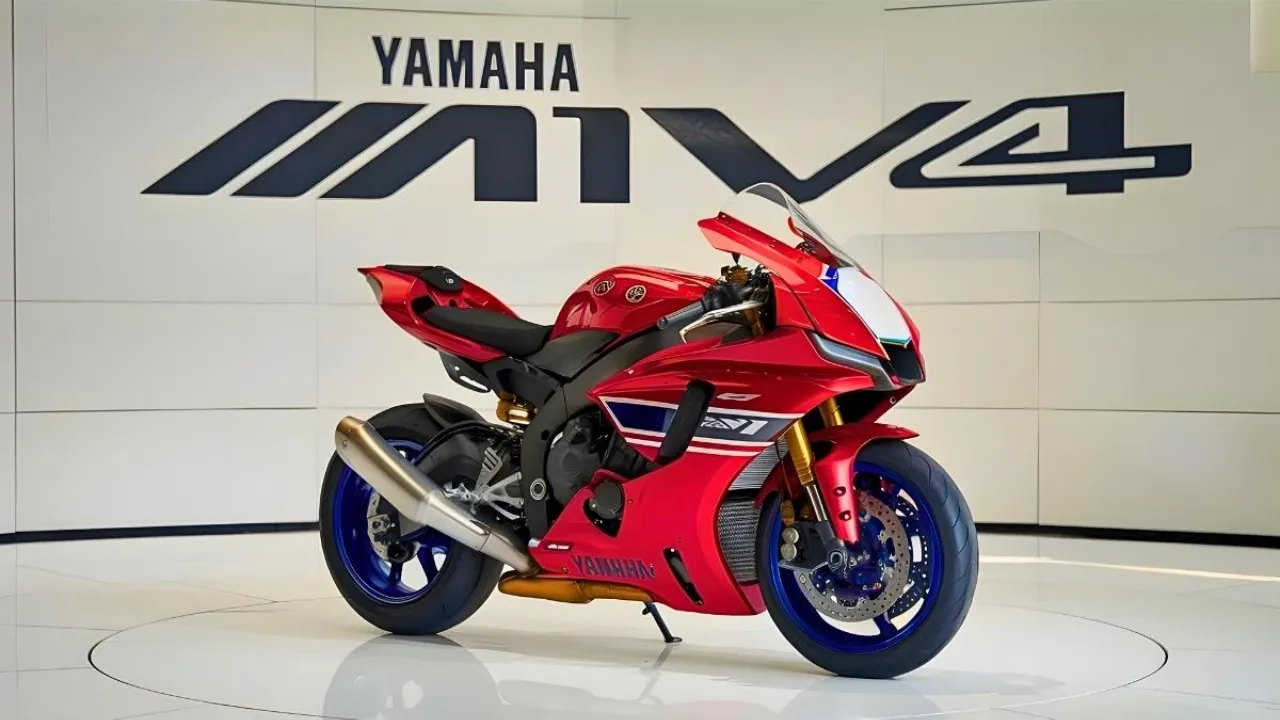
Yamaha has officially entered a transformative phase in its MotoGP journey with the unveiling of the 2026 Yamaha M1 V4. For decades, the Yamaha M1 stood apart from the competition by remaining loyal to its inline-four engine, a design celebrated for its balance, smooth power delivery, and exceptional cornering precision. However, as MotoGP technology and competition continue to evolve, Yamaha has made a decisive move that could redefine its future on the grid.
The introduction of a V4-powered Yamaha M1 is not merely a technical update. It represents a strategic shift aimed at restoring long-term competitiveness in a championship increasingly dominated by V4 machines. This historic change has drawn significant attention from fans, engineers, and riders, all eager to see how Yamaha blends innovation with its traditional strengths.
A Defining Moment in Yamaha’s Racing History
Switching from an inline-four to a V4 engine marks one of the most significant decisions in Yamaha’s MotoGP history. The inline-four configuration was deeply embedded in the M1’s identity, offering predictable handling and rider-friendly performance. Yet, rivals using V4 engines steadily gained advantages in acceleration, top-speed efficiency, and aerodynamic integration.
The 2026 Yamaha M1 V4 acknowledges these realities while demonstrating Yamaha’s willingness to adapt without abandoning its core philosophy. Rather than chasing raw numbers, the development focus has reportedly centered on maintaining rideability, consistency, and control—qualities that have long defined Yamaha’s race bikes.
Inside the New Yamaha V4 Engine
At the heart of the 2026 M1 lies an all-new V4 MotoGP engine, developed specifically to meet modern racing demands and regulations. The compact nature of the V4 layout allows for improved mass centralization, which plays a crucial role in enhancing rear traction and stability under acceleration.
This configuration also enables higher top-end performance while maintaining a smooth and manageable power curve. Yamaha’s engineers have prioritized throttle precision and predictable power delivery, ensuring riders can exploit the engine’s performance throughout a full race distance. The distinct sound of the V4 further underscores the beginning of a new identity for the M1.
Chassis Development and Handling Balance
Despite adopting a new engine architecture, Yamaha has remained committed to its reputation for superior handling. The 2026 Yamaha M1 V4 chassis has been redesigned to complement the V4 layout while preserving front-end feedback and corner entry confidence.
Refinements to frame geometry, swingarm design, and suspension settings aim to manage the increased torque output without sacrificing agility. The result is a motorcycle that remains composed under hard braking, stable through fast corners, and responsive in technical sections. This balance highlights Yamaha’s integrated development approach rather than focusing on isolated performance gains.
Advanced Aerodynamics for Modern MotoGP
Aerodynamics play a central role in contemporary MotoGP, and the 2026 M1 V4 reflects this evolution. Yamaha has introduced a revised aerodynamic package featuring updated winglets and refined fairing contours designed to increase downforce and reduce front-end lift.
These aerodynamic elements are carefully integrated to maintain efficiency while minimizing drag. Improved airflow management supports cooling and stability, particularly on high-speed circuits where aerodynamic efficiency can significantly impact lap times.
Electronics and Rider Control Enhancements
The electronics package on the 2026 Yamaha M1 V4 has been recalibrated to suit the characteristics of the new engine. Updated traction control, engine braking systems, and power maps allow riders to adapt quickly to varying track conditions, tire wear, and fuel loads.
This refined electronics strategy ensures that performance gains remain accessible and controllable, reinforcing Yamaha’s rider-focused development philosophy. Consistency and adaptability remain key priorities in race-winning performance.
Impact on Yamaha Riders and Team Strategy
For Yamaha’s riders, the transition to a V4-powered machine presents both challenges and opportunities. While adaptation will be required, the new platform offers improved straight-line competitiveness and enhanced race versatility.
The M1 V4 provides a stronger foundation for battling at the front, especially on tracks where acceleration and top speed previously posed limitations. With continued refinement, the bike has the potential to evolve into a genuine championship contender.
Fan Response and MotoGP Significance
The reveal of the 2026 Yamaha M1 V4 has sparked widespread discussion within the MotoGP community. Many fans view it as a necessary evolution, while others recognize it as the end of a distinctive era. Regardless of sentiment, the move underscores Yamaha’s commitment to innovation and long-term success.
This shift also highlights the relentless pace of MotoGP development, where manufacturers must continuously adapt to remain competitive at the highest level.
Disclaimer
This article is based on early information, industry reports, and official announcements available at the time of writing. Final specifications, performance data, and design details may change as development progresses. Readers are advised to follow official Yamaha and MotoGP communications for the most accurate updates.

Hi, I’m Zeeshan, the author behind PPdmuar. I run this website to share helpful and easy-to-understand content about mobile technology and automobiles. I enjoy researching new topics, learning how things work, and then explaining them in a simple way so anyone can understand.